Freshly harvested tobacco leaves have high moisture content; avoid rapid heating and early dehumidification after loading.
In flue-cured tobacco production, what truly determines leaf quality is not simply raising the temperature, but controlling the balance between leaf internal vital activity, water loss rate, and chemical changes at different time points. A mature flue-curing process is essentially a complex biochemical regulation completed within 5 to 7 days.
In my opinion, many new curing devices solve the problem of "control precision," but they do not solve the problem of "judging leaf condition." A thermometer showing 38°C does not mean all tobacco leaves are in the optimal yellowing environment.
I. Pre-curing Leaf Condition Assessment
The yellowing stage is the most critical phase, requiring temperatures of 32–42°C, humidity 80%–95%, for 48–72 hours.
Freshly harvested mature tobacco leaves typically have a high moisture content, with fresh leaf water accounting for about 80%. At this time, the leaves still maintain certain physiological activity.
After loading, two mistakes must first be avoided:
First, heating up too quickly.
Second, dehumidifying too early.
If the leaves have not completed their natural yellowing process, rapidly reducing humidity will prevent adequate chlorophyll degradation, resulting in "green veins and green patches."
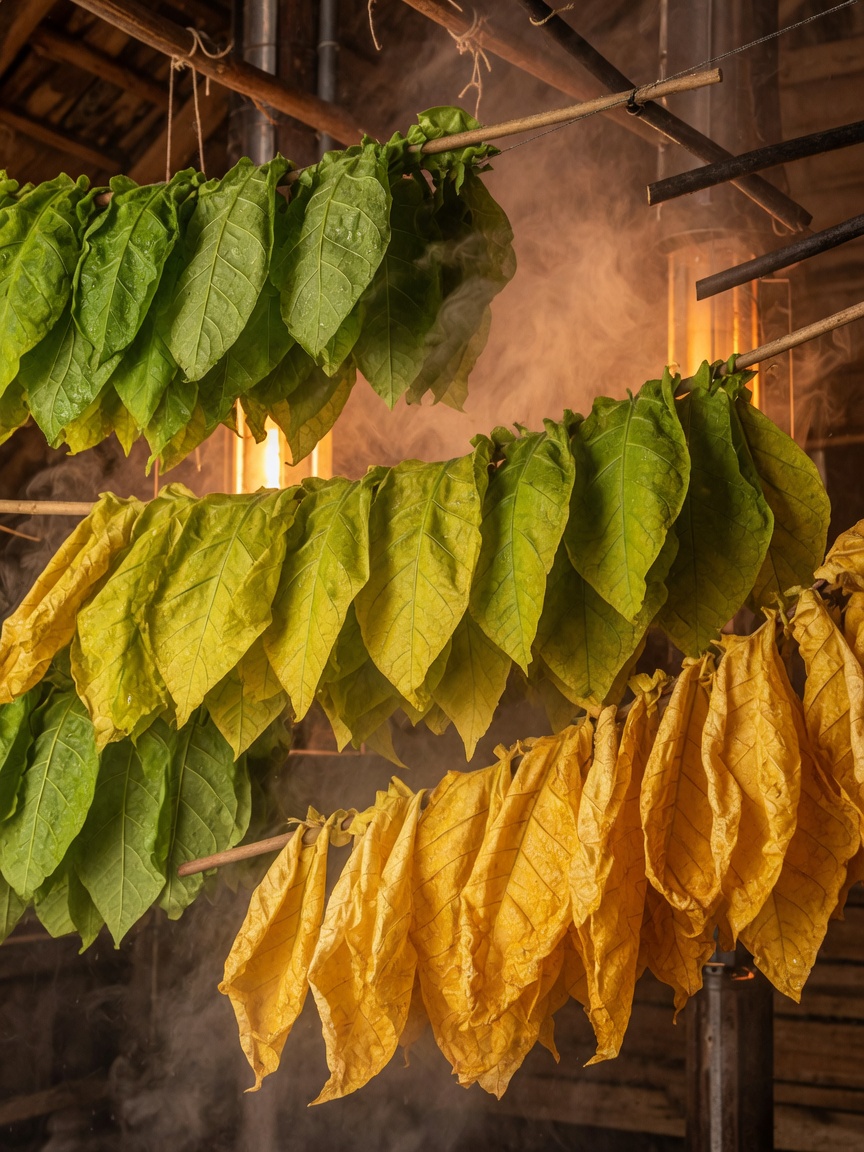
II. Yellowing Stage Parameter Control
The core of the color-fixing stage is to rapidly halt leaf vital activity while preserving the yellow color; heating rate is about 1°C/hour.
Typical parameters:
- Temperature: 32–38°C
- Gradually increased to 40–42°C in the later stage
- Relative humidity: 80%–95%
- Duration: 48–72 hours
The yellowing stage is the most critical phase of the entire curing process.
This stage cannot be simply understood as "turning the leaves yellow"; rather, it allows the leaves to continue completing:
- Conversion of starch to reducing sugars
- Chlorophyll decomposition
- Protein degradation
- Aroma precursor formation
My experience is that during the yellowing stage, it is better to go slower rather than rush.
In a 2018 curing trial in Qujing, Yunnan, a batch of K326 middle leaves was processed using a traditional bulk curing barn. The operators, aiming for speed, raised the temperature directly to 42°C within 6 hours of loading. After 72 hours, although the color was close to yellow, the leaf aroma was noticeably insufficient, and the smoke irritation increased after burning.
The plan was later adjusted:
Keep around 35°C for the first 12 hours;
Slowly raise to 38°C after 24 hours;
After 48 hours, once the leaf tip and leaf base colors were synchronized, proceed to the color-fixing stage.
The final leaf oil content and aroma improved significantly.
III. Color-fixing Stage Parameter Control
The stem-drying stage mainly reduces midrib moisture at 55–68°C for 24–48 hours.
Core objectives of the color-fixing stage:
Rapidly halt leaf vital activity while preserving the already formed yellow coloration.
Typical parameters:
- Temperature: 42–54°C
- Relative humidity gradually decreasing
- Duration: 36–48 hours
The heating rate in this stage is typically controlled at about 1°C per hour.
If heating is too fast:
- Leaf surface dries first
- Internal moisture cannot be released
- Prone to ash-marked and stiff leaves
If heating is too slow:
- Enzyme activity persists too long
- Increased sugar consumption
- Loss of aroma precursors
I believe the color-fixing stage is the most underestimated. Many people focus on the final temperature but overlook the transitional process between 42–48°C.
IV. Stem-drying Stage Control
Temperature and humidity control directly affects the formation and retention of sugars, nicotine, and aroma substances.
The main task of the stem-drying stage is to reduce midrib moisture content.
Parameter range:
- Temperature: 55–68°C
- Duration: 24–48 hours
- Humidity continuously decreasing
The final midrib needs to reach a fully dry state.
A temperature exceeding 70°C is not necessarily better.
Excessively high temperatures may cause:
- Sugar decomposition
- Aroma loss
- Leaf color darkening
V. Effects of Temperature and Humidity on Leaf Chemical Composition
The curing process significantly influences the formation of tobacco leaf combustion characteristics.
### 1. Sugars
Proper yellowing promotes carbohydrate conversion, keeping reducing sugars within an appropriate range.
Low sugar levels:
Harsh smoke;
High sugar levels:
Prone to producing a sweet-burnt sensation while affecting combustion balance.
### 2. Nicotine
Nicotine changes are mainly influenced by maturity and the curing process.
Rapid high temperatures cause:
Prominent nicotine irritation;
Slow, reasonable processing:
Improves smoking harmony.
### 3. Aroma Substances
Aroma substances produced by carotenoid degradation are an important quality source for flue-cured tobacco leaves.
Unreasonable temperature and humidity control leads to:
- Insufficient aroma
- Increased woody note
- Increased off-flavors
VI. Formation of Combustion Characteristics
Automated control solves execution; experience solves decision-making.
Many people think combustion quality comes mainly from the leaf itself, but the curing effect is very significant.
Well-cured tobacco leaves:
- Uniform moisture
- Stable tissue structure
- Compact ash
Performance:
- Easy to ignite
- Stable burning rate
- Complete ash column
If color-fixing is too rushed:
Abnormal leaf tissue contraction, prone to extinguishing during combustion.
VII. Manual Experience and Automated Control
Controlling three rhythms—yellowing speed, moisture release speed, and heating/kill-green speed—is the key.
Modern bulk curing barns can precisely control temperature and humidity, but in my view:
Automated control solves "execution"; experience solves "decision-making."
For example:
At the same 38°C, 85% humidity:
Tobacco leaves from high-altitude Yunnan areas and those from Henan plains react completely differently.
Reasons include:
- Leaf thickness
- Initial moisture content
- Maturity level
- Soil conditions
A truly excellent curing operator observes:
Leaf tip change rate;
Leaf softness;
Midrib condition;
Color uniformity.
VIII. Personal Technical Judgment
After many years of observation, I believe the most important aspect of flue-cured tobacco curing is not pursuing the fastest completion, but controlling three rhythms:
First, yellowing speed.
Second, moisture release speed.
Third, heating and kill-green speed.
When these three rhythms match, leaf quality naturally stabilizes.
The future development direction of curing technology will not only be higher precision sensors, but using data models to judge leaf condition, enabling equipment to possess judgment abilities similar to experienced technicians.
Reference materials indicate that flue-cured tobacco curing is typically divided into three stages: yellowing, leaf drying, and stem drying, with a total cycle of about 5 to 7 days; different stages control internal leaf chemical changes through temperature, humidity, and dehumidification rate. Related studies also point out that maintaining higher humidity during the yellowing stage facilitates chlorophyll degradation and color formation, while subsequent stages require gradually increasing temperature and reducing humidity to complete color fixation and drying.